Drip vs MailerLite: Pricing and Automation Compared
Drip is $39/mo at 2,500 people; MailerLite is free to 250 subscribers and $19 at 1,000. What the gap buys in drip automation, with prices from both vendors.
TL;DR verdict
For most senders MailerLite is the better pick: at 5,000 subscribers its Comfort plan is $49 a month against $89 for Drip, and it starts free. Choose Drip instead when most of your revenue comes through an online store and your drips need cart, order and product data, because that store-level reporting is what the extra money pays for. MailerLite offers a 250-subscriber free plan with three automations; Drip offers a 14-day trial.
Drip
Better for stores that want revenue traced to each email and workflows built around orders.
MailerLite
Better for small lists and tight budgets: free to start, $19 at 1,000 subscribers, $49 at 5,000.
These two sit at opposite ends of the price range for list-based email, which is why the useful question is not which has more features but which features you will actually use at your list size.
Quick comparison
| Feature | Drip | MailerLite | Better fit |
|---|---|---|---|
| Free option | 14-day trial, no credit card; no ongoing free plan | Free plan: 250 subscribers, 2,500 emails a month, 2 seats, 3 automations of up to 5 steps | MailerLite |
| Price at about 1,000 people | $39/mo (the same price covers up to 2,500) | Comfort $19/mo, Power $39/mo | MailerLite |
| Price at about 5,000 | $89/mo | Comfort $49/mo, Power $69/mo | MailerLite |
| Price at about 10,000 | $154/mo | Comfort $89/mo, Power $129/mo | MailerLite |
| Price at about 25,000 | $369/mo | Comfort $179/mo, Power $239/mo | MailerLite |
| Email sends | Unlimited up to 30,000 people; 480,000 sends listed at 40,000 and 600,000 at 50,000 | Comfort: ten times the subscriber tier; Power: unlimited | Tie |
| Automation limits | Up to 50 workflows listed on the plans | Free: 3 automations, 5 steps; Comfort: 50 automations, 100 steps; Power: unlimited automations | Tie |
| Store data in drips | Revenue traced to the email that earned it; Shopify, WooCommerce, BigCommerce and 90+ more integrations | Ecommerce triggers and sales tracking in its plan table; Shopify, WooCommerce and Stripe among 100+ integrations | Drip |
| Landing pages and websites | Onsite pop-up campaigns; no website builder listed on its pricing page | Free: 1 site and 1 landing page; Comfort: 10; Power: unlimited | MailerLite |
| SMS | Available, priced by subscribers and message segments | Not listed on its pricing page | Drip |
| Transactional email | Billed within the same usage model | Not included; sold separately as MailerSend | Drip |
| Support | Email support at 5,000 people; chat and email from 10,000 | Power adds 24/7 live chat | Tie |
Pricing
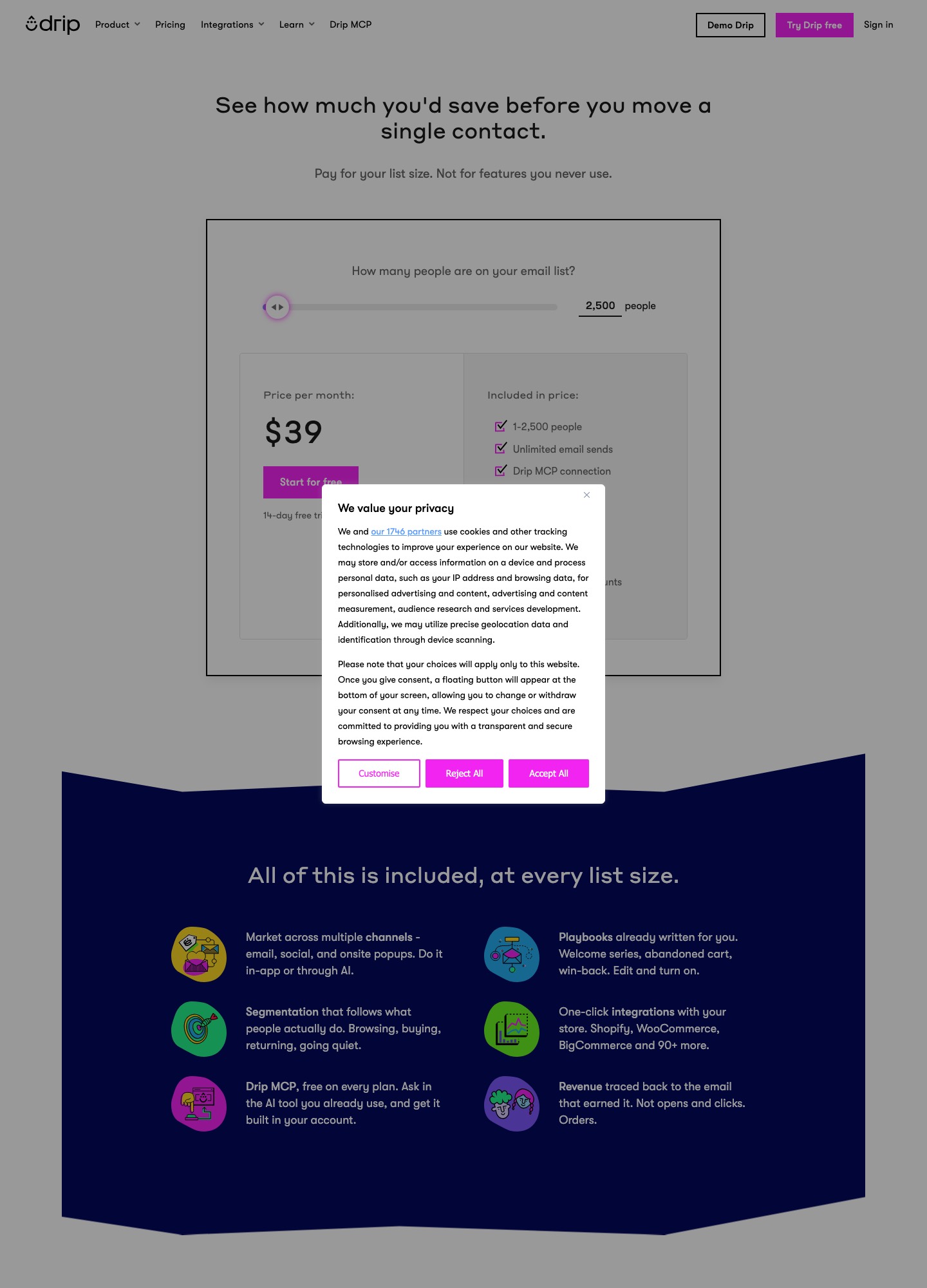
Drip quotes one price per list size: $39 up to 2,500 people, $89 at 5,000 people, $154 at 10,000 people and $369 at 25,000 people, all with unlimited sends. MailerLite quotes two plans per list size, Comfort and Power, plus a free plan up to 250 subscribers. At every size both pages show, MailerLite's cheaper plan costs roughly half to 60% of Drip's price, so the question is what the difference buys you.
Drip free option
14-day free trial, no credit card required
$39/mo at 2,500 people, $154/mo at 10,000
MailerLite free option
Free plan: 250 subscribers, 2,500 emails/mo, 2 seats, 3 automations of up to 5 steps, 1 site and 1 landing page
Comfort $19/mo and Power $39/mo at 1,000 subscribers
| Tier | Drip | MailerLite |
|---|---|---|
| About 1,000 people | $39/mo — The first tier covers 1 to 2,500 people | Comfort $19, Power $39 — Monthly billing; yearly billing is cheaper (Comfort lists $10.80/mo at 500 subscribers) |
| About 5,000 | $89/mo — 4,501 to 5,000 people, email support | Comfort $49, Power $69 — Comfort: 50 automations; Power: unlimited |
| About 10,000 | $154/mo — 9,001 to 10,000 people, chat and email support | Comfort $89, Power $129 — Power adds unlimited emails and 24/7 live chat |
| About 25,000 | $369/mo — 22,501 to 25,000 people, free migration and onboarding | Comfort $179, Power $239 — Enterprise plans are for lists over 200,000 |
Against Comfort the gap is 40 dollars a month at 5,000 (480 dollars a year), 65 dollars a month at 10,000 (780 dollars a year) and 190 dollars a month at 25,000 (2,280 dollars a year). Against Power it is smaller: 20, 25 and 130 dollars a month at the same sizes. Whether Drip is worth that depends on how much of your revenue its store-level reporting and workflows help you earn.
Prices are read from each vendor's pricing page on 7 October 2026 and change without notice. Drip's numbers come from typing each list size into its slider; MailerLite's come from its published subscriber tiers.
What the same list costs in each tool
Take a store with 5,000 people on its list. Drip's slider shows $89 a month for 4,501 to 5,000 people. MailerLite shows $49 for Comfort and $69 for Power at 5,000 subscribers. Over twelve months that is $1,068 a year for Drip against $588 a year for Comfort or $828 a year for Power. At 10,000, Drip costs $1,848 a year, Comfort $1,068 a year and Power $1,548 a year.
Two details shift that picture. MailerLite lists cheaper yearly billing (Comfort $10.80 a month instead of $12, Power $22.50 instead of $25, quoted at 500 subscribers), whereas Drip's slider readout is a single monthly figure per size. And at the bottom of the range MailerLite's free plan means $0 for up to 250 subscribers and 2,500 emails a month, while Drip has nothing beyond its 14-day trial, so even a small list you want to keep warm costs $39 a month there.
Automation limits, plan by plan
MailerLite's pricing page spells out how many automations each plan runs: 3 active automations of up to 5 steps on Free, 50 with up to 100 steps on Comfort, and unlimited automations on Power, which also adds multiple automation triggers. A store that wants a welcome series, an abandoned-cart flow, a post-purchase flow and a win-back flow needs four automations, so the free plan is enough to test an idea but not to run the program; Comfort covers it with room to spare.
Drip's plans list up to 50 workflows and do not tier that by price, so the practical difference between the two is the free plan rather than the ceiling. If you are on Power only because you want one automation to start from several different events, check whether you can restructure it into two before paying the gap.
Where store data changes the answer
Both vendors list store connections. Drip names Shopify, WooCommerce and BigCommerce and says there are more than ninety other one-click integrations; MailerLite's plan table lists ecommerce triggers, ecommerce sales tracking and Shopify and WooCommerce integrations. What differs is how each frames revenue. Drip's page says revenue is "traced back to the email that earned it. Not opens and clicks. Orders." MailerLite lists sales tracking as one feature beside websites, landing pages and digital products.
Run a break-even test on your own numbers. At 5,000 people Drip is 40 dollars a month more than MailerLite Comfort. If a Drip workflow you could not build in MailerLite earns your store more than that in margin each month, it pays for itself. If every flow you plan is a welcome series, a cart reminder and a win-back, either tool can send those and the premium buys you little.
What each one adds beyond drips
MailerLite's plan table includes websites and landing pages (one of each on Free, up to ten on Comfort, unlimited on Power), signup forms, three email editors, and on Power digital products and bookings, plus 24/7 live chat. If the goal is one login for site, signup form and drips, that bundle is the argument for it.
Drip's pricing page lists onsite campaigns (pop-ups), SMS priced by subscribers and message segments, and transactional email billed inside the same usage model, and it does not list a website builder. Its support also scales with list size: email support at 5,000 people, chat and email from 10,000, and free migration with personalized onboarding on the 25,000-person plan.
Two switching details worth knowing first
MailerLite's help text says that on a free account, once active subscribers pass the 250 limit, sending is locked for campaigns and automations until you upgrade or remove subscribers. If you are moving a larger list from Drip, start on a paid plan rather than the free one. The same help text says every account gets 14 days to test certain premium features, which is the closest MailerLite equivalent of Drip's 14-day trial.
In the other direction, Drip's free migration is listed only on the 25,000-person plan, so a smaller list does the import itself: export the MailerLite subscriber list, map groups to tags and rebuild the automations by hand, as the migration table below describes.
Pros and cons
Drip
Pros
- One price per list size, with unlimited sends listed up to 30,000 people
- Reports revenue per email, not only opens and clicks, according to its own pricing page
- Store integrations with Shopify, WooCommerce and BigCommerce, plus more than ninety others
- SMS and transactional email sit inside the same usage-based bill
- Free migration and personalized onboarding on the 25,000-person plan
Cons
- No ongoing free plan, only a 14-day trial
- Costs roughly 1.8 to 2 times MailerLite Comfort at 5,000 and 25,000 people
- No website or landing-page builder listed on its pricing page
- Built around orders and carts, so a non-store list gets less from the price
- Email support only at 5,000 people; chat begins at 10,000
MailerLite
Pros
- A free plan: 250 subscribers, 2,500 emails a month and three automations
- Comfort is $19 at 1,000 subscribers and $49 at 5,000, with cheaper yearly billing
- Websites, landing pages and signup forms on every plan, up to unlimited on Power
- Power adds unlimited automations, digital products, bookings and 24/7 live chat
- Lists Shopify, WooCommerce and Stripe integrations among 100+
Cons
- Sending locks once a free account passes 250 active subscribers
- The free plan allows only 3 automations of up to 5 steps each
- No SMS listed, and transactional email is a separate product (MailerSend)
- Store reporting is one feature among many rather than the centre of the product
- Multiple automation triggers are a Power-plan feature
Best for these scenarios
A Shopify store with 5,000 customers and four store flows
Pick: DripWelcome, abandoned cart, post-purchase and win-back, with revenue judged per email.
Drip reports revenue per email and is organised around orders. The 40 dollars a month it costs over MailerLite Comfort at 5,000 is repaid if those flows earn more than that in margin.
A creator with 800 subscribers
Pick: MailerLiteA newsletter plus a signup page and a short welcome sequence.
MailerLite quotes $19 a month for Comfort at 1,000 subscribers and includes websites, landing pages and forms; Drip starts at $39 and lists no site builder.
A new shop with under 250 contacts
Pick: MailerLiteTesting demand before committing to a monthly bill.
The free plan covers 250 subscribers and 3 automations, enough for welcome, cart and win-back. Upgrade before passing 250 active subscribers, because sending locks beyond that.
A store that also texts customers
Pick: DripEmail and SMS from one list, with SMS tied to purchase events.
Drip lists SMS priced by subscribers and message segments; MailerLite does not list SMS on its pricing page.
A service business that wants a site, a form and drips in one login
Pick: MailerLiteA local business or consultant with a modest list.
MailerLite includes a website and landing pages on every plan (up to unlimited on Power) alongside automations.
A store with 25,000 people and a tight budget
Pick: MailerLiteDrip costs $369 a month at this size; MailerLite costs $179 or $239.
The yearly gap is as much as 2,280 dollars. Test MailerLite's ecommerce triggers first, and move to Drip only if you miss per-email revenue reporting.
Migration plans
Drip → MailerLite
Difficulty: Moderate: contacts move easily, automations are rebuilt by hand
Time: A few days including testing
Warnings
- Personalization written for Drip has to be rewritten with MailerLite's merge tags and retested with real subscriber data
- Per-email revenue history stays in Drip, so export those reports before cancelling
- Keep Drip active until each new automation has run through a full cycle, which means paying for both briefly
MailerLite → Drip
Difficulty: Moderate: the bill and the tool both change
Time: A few days including testing
Warnings
- Websites and landing pages built in MailerLite need another host, since Drip's pricing page lists no site builder
- Expect the monthly bill to roughly double at the same list size
- MailerLite's digital products and bookings have no listed equivalent in Drip
| Direction | Step | Success criteria |
|---|---|---|
| Drip → MailerLite | Export the people list from Drip as a CSV with tags and custom fields | Moderate: contacts move easily, automations are rebuilt by hand |
| Drip → MailerLite | If the list is over 250 people, start on a paid MailerLite plan, because a free account locks sending past 250 active subscribers | Moderate: contacts move easily, automations are rebuilt by hand |
| Drip → MailerLite | Import the CSV and map Drip tags to MailerLite groups | Moderate: contacts move easily, automations are rebuilt by hand |
| Drip → MailerLite | Rebuild each Drip workflow as a MailerLite automation, checking the plan's limits (3 automations and 5 steps on Free, 50 and 100 on Comfort) | Moderate: contacts move easily, automations are rebuilt by hand |
| Drip → MailerLite | Connect your store through MailerLite's Shopify or WooCommerce integration and confirm cart and order triggers fire on a test purchase | Moderate: contacts move easily, automations are rebuilt by hand |
| Drip → MailerLite | Recreate templates in one of MailerLite's three editors and send a test of every automation to an inbox you control | Moderate: contacts move easily, automations are rebuilt by hand |
| MailerLite → Drip | Export subscribers from MailerLite as a CSV with all custom fields | Moderate: the bill and the tool both change |
| MailerLite → Drip | Pick the Drip plan for your list size from the slider (for example $89 a month at 5,000 or $154 at 10,000) | Moderate: the bill and the tool both change |
| MailerLite → Drip | Import into Drip and turn MailerLite groups into Drip tags | Moderate: the bill and the tool both change |
| MailerLite → Drip | Rebuild each automation as a Drip workflow and connect Shopify, WooCommerce or BigCommerce | Moderate: the bill and the tool both change |
| MailerLite → Drip | Check that purchases are tracked and revenue appears against a test email | Moderate: the bill and the tool both change |
| MailerLite → Drip | On the 25,000-person plan, ask Drip about the free migration its pricing page lists | Moderate: the bill and the tool both change |
Frequently asked questions
Is MailerLite's free plan enough for drip emails?
It is enough to test. The free plan allows 250 subscribers, 2,500 emails a month, 3 active automations of up to 5 steps and one site and landing page. That covers a welcome series and a couple of short flows, but sending locks once active subscribers pass 250, so plan to move to Comfort ($19 a month at 1,000 subscribers) before you grow past it.
How much more does Drip cost than MailerLite?
At 5,000 people Drip is $89 a month against $49 for MailerLite Comfort or $69 for Power. At 10,000 it is $154 against $89 or $129, and at 25,000 it is $369 against $179 or $239. Drip has no free plan; MailerLite does.
Is Drip better than MailerLite for an online store?
Drip is built around the store: its pricing page describes revenue traced to the email that earned it, integrations with Shopify, WooCommerce and BigCommerce, and SMS. MailerLite also lists ecommerce triggers and sales tracking, so the honest test is to rebuild your cart and post-purchase flows in both trials and compare what each reports.
Can I move from MailerLite to Drip without losing subscribers?
Yes. Export your subscribers to a CSV, import them into Drip and convert MailerLite groups into Drip tags. The automations do not transfer, so rebuild them as workflows and test them before you switch your sending over. Drip lists free migration on its 25,000-person plan.
Does either tool handle SMS or transactional email?
Drip lists SMS (priced by subscribers and message segments) and bills transactional email inside the same usage model. MailerLite does not list SMS on its pricing page, and says transactional email is provided by its separate product MailerSend.
Should I start on MailerLite and move to Drip later?
It is a reasonable path if you are not yet sure the drips will earn money. Start free, build the welcome and cart flows, and move when you can point to a flow that Drip would improve. Moving later costs a few days of rebuilding, not your list.
Which should you choose?
Choose Drip if…
- Most of your revenue comes through an online store and you judge drips by orders
- You want revenue traced to each email rather than opens and clicks
- You also plan to send SMS to the same list
- You can name a store workflow that earns more than the gap over MailerLite
Choose MailerLite if…
- You want a free plan to start on, or have under about 1,000 subscribers
- You want a website, landing pages and forms in the same login as your drips
- Your drips are welcome, cart reminder and win-back rather than product-level workflows
- Every dollar of monthly cost matters: Comfort is $49 at 5,000 against $89
Where the numbers come from
Related comparisons
Browse the full comparison library, the 15-tool shortlist, or the drip strategy guides.